Can a small business compete with companies that have larger marketing budgets?
Yes. Search today rewards relevance, expertise, and trust more than company size. Small businesses that invest in SEO, publish helpful content, and build customer trust can often outrank much larger competitors in both traditional search results and AI-powered search.
If you run a service business, local brand, or contractor company, your advantage isn’t size. It’s focus, speed, and how close you are to your customers. A smart small business marketing strategy doesn’t try to copy big companies; it plays a different game entirely.
This guide breaks down practical ways to compete without needing a huge budget.
Search Has Changed. Visibility Means More Than Google Rankings
Today, people have little patience; they expect fast answers to every question.
Search has changed, and it has now gone beyond the old ways of Google results. 37% consumer now ask questions directly to the AI search tools to get the best suggested answers, such as through
- ChatGPT
- Google AI overview
- Perplexity
In short, your business wants content that answers clearly, demonstrates expertise, and provides helpful details. Not just the content, but with those targeted keywords. Companies that build trust through good content are more likely to get reach in both search results and AI-powered answers.
How to Show Up in ChatGPT and AI Overviews (Not Just Google)
Old SEO is still important, but now AI search is changing how people explore differently:
To enhance your visibility:
- Write clear, question-based headings.
- Add FAQ sections to important pages.
- Keep your business information consistent.
- Publish expert, trustworthy content.
- Encourage detailed customer reviews.
- Use structured internal linking.
These signals help search engines and AI models understand your business more effectively.
The Questions Your Customers Google Before They Ever Call You
Before buying any product, the user has questions to make a wise decision.
It includes:
- How much do these services cost?
- How long will it take?
- Which is right for me?
- Why should I choose the XYZ company?
Publishing or creating content that answers these questions for users helps them to trust the company and make informed decisions while increasing your chance of appearing in AI search results.
Why a 5-Person Company Can Outrank a 500-Person One
Large companies go broad. They target wide audiences, generic keywords, and standardized messaging. That approach works at scale, but it leaves gaps.
You don’t need to rank for “roofing services” across an entire state. You need to show up for “emergency roof repair near me” in your service area. You don’t need hundreds of reviews overnight; you need recent, detailed ones that build trust quickly.
Similarities can beat size; when your website content, services, and messaging line up exactly with what someone is seeking, you become the obvious choice. That’s where small businesses win.
Stop Trying to Be Everything to Everyone
Small entrepreneurs try to provide everything to the user, which is a big mistake. It leads you to drag in direct competition from the bigger companies that offer more services. So narrow your focus for better results.
However, if someone targets a different type of user with a different level of urgency. If a user finds a specific service, they are usually closer to hiring. If your page matches that exact requirement.
While the target according to your niche perfectly works, it helps you to achieve both at the same time: lower the competition and improve conversion rates.
Big Companies Are Bad at Local. Use That.
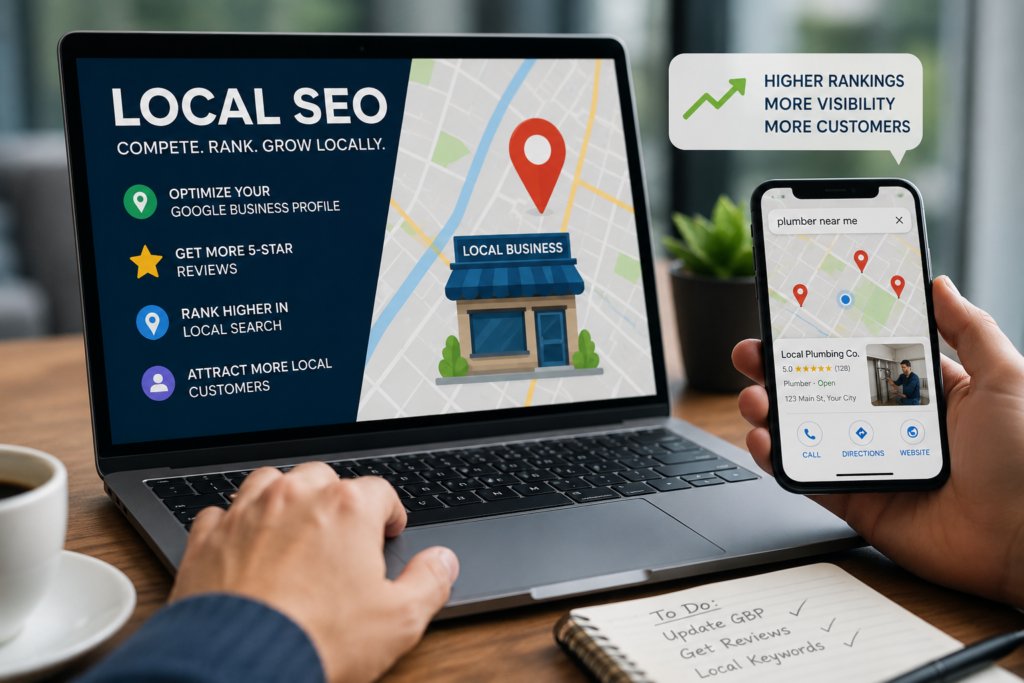
Big companies rarely go deep at the local level. Their location pages are often generic, with little real value.
That’s your opportunity.
Start with your Google Business Profile. It just takes you to ensure your categories, services, business hours, and photos are accurate. Must keep it updated with new images.
Then focus on your website.
Instead of relying on one “Service Areas” page, build individual pages for each town or neighborhood you serve. And don’t just swap city names; write content that reflects that location.
Talk about:
- Common home styles in the area
- Typical problems homeowners face
- Weather-related issues
- Local SEO strategy expectations or concerns
When someone lands on that page, it should feel like it was written for their area, not copied from somewhere else.
That’s what helps you rank and convert.
One Great Review Beats Fifty Vague Ones
Authority and good reviews are some of the best trust signals you have. Big brands may have more reviews, but they are mostly vague or outdated. However, small businesses can just easily grab attention just by focusing on quality.
Ask customers to leave reviews that mention:
- The exact service you provided
- The problem you solved
- Their experience working with you
Specific reviews carry more weight. They help future customers picture what it’s like to hire you. Also, respond to every review. These will help you to be active and pay attention. It helps to be more active and pay attention. Giving just a small reply makes a huge difference.
Write for Your Neighborhood, Not the Internet
Content is where small businesses can pull ahead if it’s done right.
Most big companies publish broad blog posts that target general keywords. You can go deeper.
Instead of writing “How to Fix a Leaky Faucet.”
Write:
“Why Faucets Leak in Older Homes and How to Fix It” and
“What Causes Low Water Pressure in [Your Area] Homes.”
These topics match real problems people deal with in specific places. Think about the questions customers ask you every week. Those are your best content ideas. When your content reflects real situations, it ranks better and builds trust faster. People feel like you understand their problem, not just the general version of it.
Cover Every Town You Serve On Purpose, Not by Accident
Most businesses list their service business growth areas but don’t actually cover them in depth. For your website, you need to create pages for both services and locations.
However, relying too much on one general page creates different pages for each service in each town in which you provide services. Each of your website pages should be focused on a specific category, which should be useful and connected to related pages across your overall site. Keep them frequently updated and continue adding new ones over time.
This structure helps search engines clearly understand where you work and what things you offer over time. This kind of structure helps search engines clearly understand where you work and what you offer, while also making it easier for users to quickly search for what they need.
Use Speed and Flexibility as a Weapon
Large companies move slowly. Changes go through multiple layers, which takes time. Small businesses can act immediately.
If there’s a seasonal issue, a weather event, or a new local trend, you can update your website or publish content within days. That gives you a timing advantage. Being early often matters more than being perfect. People start exploring for something unique and new; the businesses that answer first usually get the attention. That kind of flexibility is difficult for broader companies to match.
Traffic Doesn’t Pay the Bills. Conversions Do.
Obviously, the traffic of the website is important, but only traffic alone doesn’t mean a lot. The thing that matters a lot is what users do after landing on your site. Make a website that explains what you offer, shows a portfolio of your work, and helps users to get in touch with you.
Make use of authentic photos rather than stock images. Place these before and after examples where they are needed to integrate. What you can do is also add reviews and testimonials, where people will actually see your service reviews. Keep your call to action clear and direct to reach.
A lot of big company websites look polished but feel distant. A simple, honest site often converts better because it feels real.
You Don’t Need a Big Brand. You Need a Clear One.
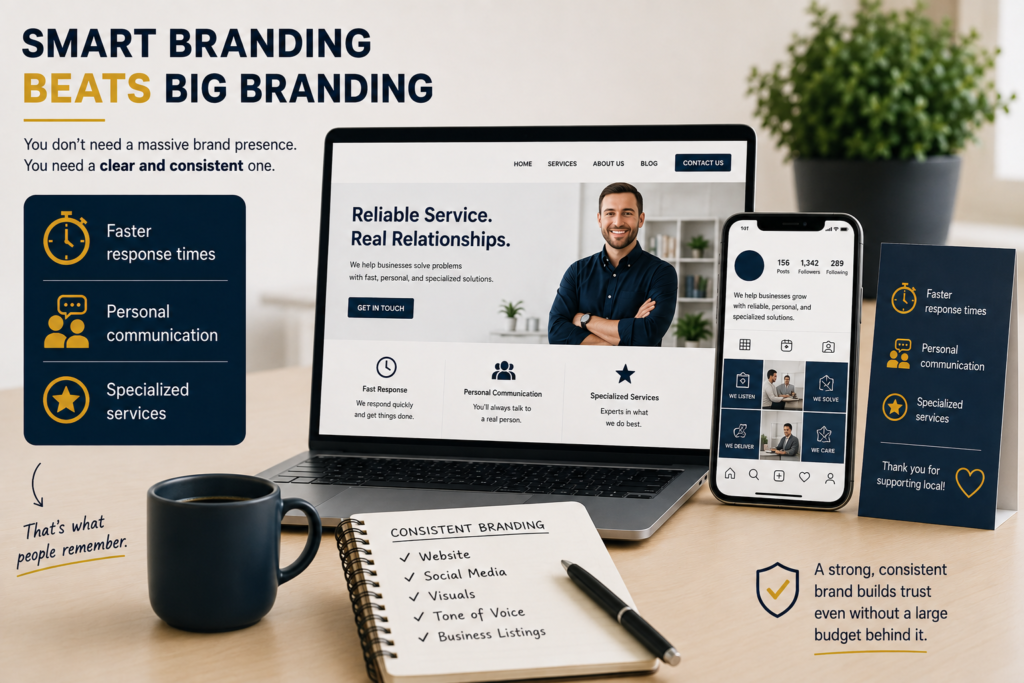
You don’t need a massive brand presence. You need a clear and consistent one. It is important to make sure that your website, messaging, visuals, and tone stay the same all across the site, social media, and other listings. You must pay attention to those things that make you different from others:
- Faster response times
- Personal communication
- Specialized services
That’s what people remember. A strong, consistent brand builds trust even without a large budget behind it.
The #1 Mistake Small Businesses Make With SEO
Most small businesses don’t struggle because of budget. They struggle because of direction.
However, the most genuine problems arise from targeting broad and highly competitive keywords. They mostly generate thin or repeated keywords and neglect local SEO basics. Small businesses mostly pay attention to paid ads, which are the most common among them.
These approaches lead to inconsistent results and ongoing competition.
The Bottom Line
You don’t need to match big companies to compete with them. You just need to use your strengths better.
Focus on what you can do that they can’t: move quickly, stay specific, and connect locally.
When you combine that with solid SEO, targeted content, and strong reviews, you create an advantage that doesn’t depend on budget. This is the same approach we used in effective marketing strategies at TheTechLabs, where the focus stays on visibility, relevance, and real customer connection instead of expensive campaigns.
- Will AI replace digital marketers? How safe are marketing jobs really?
 AI can write content, blog posts, and ad copy; schedule… Continue reading Will AI replace digital marketers? How safe are marketing jobs really?