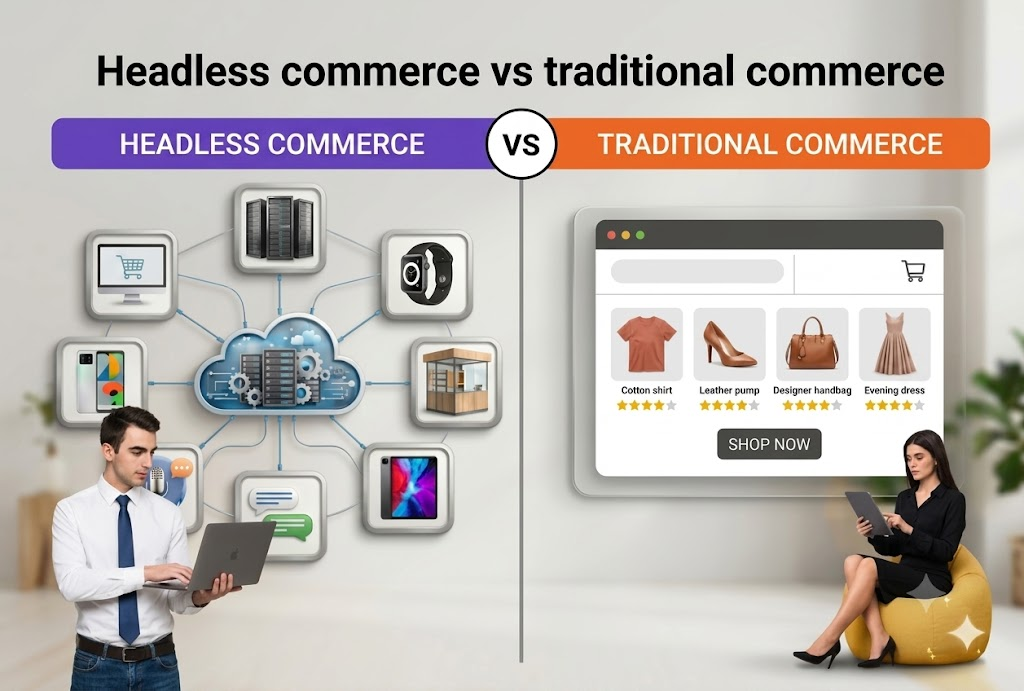
Most of the online stores appear different on the surface, but under the hood, most of them work in old ways. Their tightly packed system is built for how people shop today. Now think about how you mostly stitch from a website to an app or even shop through social media without thinking twice. It is where headless commerce starts to make sense.
It’s not just about using an online platform these days, because now things have turned into different shapes like speed, flexibility, functionality, and the ability to scale across various sites and equipment without fixing everything from scratch. And seamless user interactions are slowly changing towards a headless commerce architecture. This is all that has changed and gained a twist in the game of headless commerce.
For The Tech Labs readers, in this article, we will get to know what headless commerce is, how it actually works, and why it is becoming the future of scalable e-commerce.
What is Headless Commerce?
At its core, headless commerce is an idea of commerce in which the frontend, where the users see it, is completely detached from the backend, where business operations happen. APIs allow each side to talk to the other, instead of everything being combined.
It allows businesses to create the shopping experience on websites, apps, or even other devices as they see fit without being restricted to one layout or system. The back-end is the same, but the front-end can be changed or remade freely as per the business requirements.
A Simple Way To Understand Headless Commerce
Let’s suppose you are running an online site with a traditional setting of the website, and you are forced to use fixed templates and structures. By using BigCommerce’s headless commerce, your online site looks and works fantastically well, just like what you want it to be, just like a custom mobile app, a fast website, or even a shopping experience inside Instagram or TikTok.
Why Traditional E-commerce Feels Limiting Today
When businesses want to scale up, traditional platforms mostly struggle. Enhancing new experiences or redesigning the store mostly requires major changes or even rebuilding parts of the system. That slows everything down in a world where speed counts.
Why Businesses Are Moving Toward Headless Setups
Brands are shifting towards the headless commerce platforms because they offer the following:
- A faster performance
- Massive design freedom
- Easier expansion to multiple channels
- Better scalability for growth
How Headless Commerce Actually Works
Although it sounds too technical, the concept is quite easy to understand.
The Frontend: Where Your Customers Interact
The frontend is all that your user sees on your store, mobile app, or any digital storefront. In a headless system, it is user-friendly, meaning designers and developers can create different shopping and purchase experiences without backend restrictions.
The Backend: Where Business Logic Lives
This is where all the important tasks of the website are managed behind the scenes. It works on the product inventory, payment processing, order management, and user data.
It works like the brain of your e-commerce system, quietly managing operations.
APIs: The Bridge That Connects Everything
It is the pathway between the frontend and backend. APIs work like this: when a user clicks the “Buy Now” button, the frontend instantly sends a message through APIs, and the backend processes it immediately to act accordingly. This is what makes headless so flexible and fast.
Headless Commerce vs Traditional eCommerce: The Real Difference
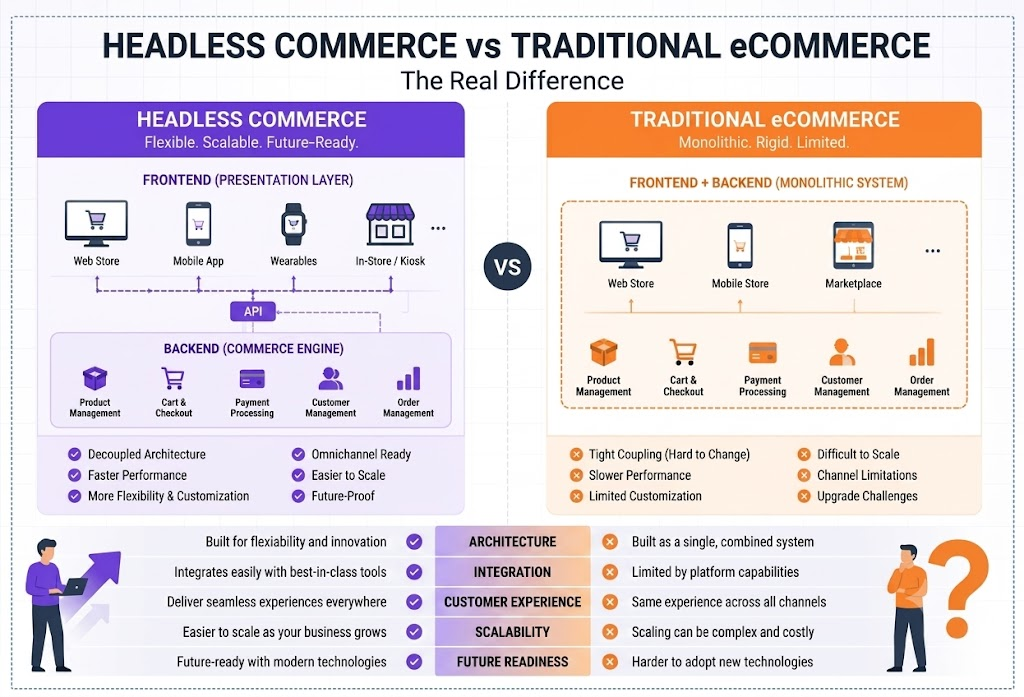
Alt: Headless commerce and traditional e-commerce side-by-side comparison.
Performance is the biggest reason why businesses shift towards the headless commerce architecture. To know in-depth about headless commerce, the comparison helps you to distinguish it from traditional systems.
Monolithic Systems
From a business aspect, traditional commerce is much easier to build up initially, but slowly it becomes difficult to scale your site. In a traditional e-commerce platform, everything is built together: design, database, checkout, and content management. It is simple to use but also rigid when you want to scale or innovate.
Flexibility, Speed, and Control: Where Headless Wins
Headless commerce removes all the restrictions. Developers easily build frontends, can do research on new technologies, and optimize performance without touching the backend.
This led to:
- Quick innovation
- User-friendly experiences
- Easier multi-channel expansion
Which Model Fits Your Business Stage?
If you are planning to start a small business, a traditional platform can be easy to get started with, but later on, it becomes difficult to handle. Meanwhile, if you want to grow fast or plan to scale across different channels, a headless commerce platform is a much more excellent option for you.
Is BigCommerce a headless CMS?
BigCommerce is not a content management system, but it is a fully capable headless commerce platform. In it, software helps the developer to disconnect the frontend using BigCommerce as the backend engine. That means creating a custom frontend by using Next.js or React is easier while using BigCommerce’s headless product management, checkout, and order process.
For heavy content websites, businesses might pair BigCommerce as a CMS with Contentful or Sanity. And this combination helps to access both commerce and content, which is a common practice in a headless commerce ecosystem. It plays a strong role in headless architecture as a commerce backend.
The Pros of Headless Commerce (Beyond the Buzzwords)
Headless commerce is not an ongoing trend. Instead, it helps businesses to solve problems.
Faster Websites That Actually Convert Better
The major benefit of headless is the speed. Even on the website, a one-second delay in loading can reduce traffic and conversion rates. Headless commerce delivers smoother and quicker user experiences.
Full Creative Control Over The User Experience
It allows you to design your website exactly how you want and how your store looks and feels. This is useful for brands that only rely on identity and storytelling.
Sell Everywhere, Not Just On Your Website
Now users do shopping from everywhere, like Instagram, mobile apps, marketplaces, and even voice assistants. Headless commerce software helps the user to expand across all these channels by using just one backend system.
Built To Scale As Your Business Grows
As traffic increases or new features are added, headless systems manage growth more effectively. You do not need to recreate your entire platform just to scale.
Challenges You Should Know Before Going Headless
While headless commerce is powerful, it is not for everyone because it cannot be used without challenges.
It’s Not Plug-And-Play
Shopify’s headless commerce-style platform setup needs development work. In it, you must have technical expertise to build and maintain the system.
Higher Upfront Investment
Because of custom development, the initial cost is usually high. Meanwhile, many businesses see potential savings in flexibility and performance.
Managing Multiple Tools Can Get Complex
A headless system depends on multiple tools for CMS, checkout, analytics, and hosting. To manage all these, you have to have a proper plan for handling these integrations.
Is Headless Commerce Valuable?
It is worth it when scalability, performance, and customization are priorities.
If you are planning to grow fast, expand into various channels, or invest in strong digital experiences that give high traffic growth, then headless commerce can give you a competitive advantage. It also allows teams to innovate more quickly without being restricted by platform limitations.
Key decision factors
Before choosing, consider:
- Your budget
- Your technical resources
- Your growth plans
- Your customer experience goals
If flexibility and scale matter more than simplicity, headless is worth serious consideration.
The Future of Headless Commerce
It is a shift toward more flexible digital systems. Key trends shaping its future include the following:
- There is runaway growth in composable commerce as companies look for more flexibility.
- AI-powered personalization is driving customer experience and conversion rates.
- Commerce is growing across social media, apps, and websites.
- Headless architecture is shaping scalable e-commerce growth.
Final Thoughts
Headless commerce has changed the perspective of traditional platforms, which are rigid and have now become a flexible API ecosystem. It enables businesses to recreate better customer experiences, scale efficiently, and integrate with new technologies without recreating the entire infrastructure.
It is the simple practice these days that companies are looking to future-proof their digital presence, understanding that headless commerce is no longer optional; it is essential.
Are you ready to future-proof your eCommerce business? Whether you’re creating a new online store or changing an existing one, a headless commerce architecture can provide the flexibility and scalability needed to stay ahead in a competitive digital marketplace.
- Will AI replace digital marketers? How safe are marketing jobs really?
 AI can write content, blog posts, and ad copy; schedule… Continue reading Will AI replace digital marketers? How safe are marketing jobs really?