AI can write content, blog posts, and ad copy; schedule social media; and even run campaign data in just one prompt away. It is no surprise that many business owners are asking one question.
Do I still need a digital marketing company, or can AI do the job instead?
The answer is not as simple as it seems yet. While AI has changed how businesses approach marketing, it still has limits that affect strategy, branding, user trust, and lasting growth opportunities.
AI is already becoming a standard part of marketing workflows. According to HubSpot’s State of AI for Marketers report, 66% of marketers worldwide use AI in their roles, showing that AI has moved beyond experimentation and into everyday marketing operations.
In this blog, we are going through what is actually happening, from the rise of AI tools to evaluating what you actually need.
The Rise of AI Tools in Marketing
For the past few years, marketing tools have changed fast. Platforms now help with keyword research, article writing, campaign startups, and even pricing strategies. In the earlier era, the work that once required a content writer, an analyst, and a campaign manager could now be done with a few prompts in a matter of seconds.
It is not a big deal for now to start small and mid-sized businesses because the barrier to entry has now dropped. Now, you do not need to start with a full marketing agency just to run ads or publish content frequently. You can do a lot just sitting in the house now, without a team.
The growth isn’t slowing down. HubSpot found that 74% of marketers now use at least one AI tool at work, up from 35% the previous year, highlighting how quickly businesses are adopting AI for marketing tasks.
And honestly, that’s exciting.
But also a bit misleading. Just because you can do it. It doesn’t mean you should handle all of it yourself.
Where AI Genuinely Pulls Its Weight
AI has its own importance and can easily handle repetitive, structured tasks. Those things that follow patterns and the things that need speed more than judgment.
You can use it to:
- Draft blog posts based on keywords
- Generate ad variations quickly
- Suggest keywords and search terms
- Schedule social media posts
- Analyze campaign data and trends
However, your main goal is to remain consistent in publishing content, running ads, and keeping things moving smoothly. AI can carry a lot of that weight to do things.
And for many businesses, that alone is a huge upgrade. There’s also a cost factor. Instead of hiring multiple specialists, you pay for tools and maybe keep a lean in-house setup. Sounds like a win. But then things start to feel off.
What AI Still Can’t Replace in Marketing
The problem isn’t capability. It’s understanding. AI doesn’t really get your business. It doesn’t feel like your customers. It doesn’t notice subtle shifts in tone or context. It just works off patterns. You might get 50 social media captions in minutes. But will they sound like you? Not really. And that matters more than people think.
Take Instagram as an example. Businesses investing in a proper Instagram marketing service aren’t just posting regularly. They’re building a presence, visual style, tone, timing, and interaction.
AI helps you suggest hashtags and captions. This is the crucial thing to know about when to respond to a comment in a certain way, or when to lean into a trend, or when not to post at all: it comes from experience and instinct; that is the gap.
AI vs Digital Marketing Agency: Who Does What Better?
| Task | AI | Marketing Agency |
| Marketing Task | AI | Human Marketers |
| Keyword research | ✓ | ✓ |
| Blog writing | ✓ | ✓ |
| Brand strategy | ✗ | ✓ |
| Customer psychology | ✗ | ✓ |
| Campaign planning | Partial | ✓ |
| Creative direction | Partial | ✓ |
AI excels at improving efficiency and automating repetitive work, while human marketers provide the strategic thinking, creativity, and decision-making that drive long-term business growth.
Strategy Is Still a Human Job
A lot of people assume marketing is just execution. Write content. Run ads. Post updates.
But that’s only part of it. The real value often sits behind the scenes:
- What’s your positioning?
- Who are you actually targeting?
- What makes you different from competitors?
- What kind of message will people remember?
AI can work with what you give it. But it doesn’t decide what direction you should take. That’s still human work. A good digital marketing service doesn’t just run tools. It builds the plan that those tools follow. And without that plan, things drift.
AI Cannot Replace Brand Strategy.
Branding is something that a lot of companies quietly turn into trouble. Because depending too much on AI for everything, such as content, everything starts sounding similar: clean, polished, and kind of forgettable. You’ve probably noticed it. Different brands, same tone. Same structure. Same phrasing.
It blends. A branding company is not just choosing colors or creating a logo. It’s finding out what your business actually wants, how it sounds when you communicate, and why someone should choose you over someone else. That process takes conversation. Back and forth. Missteps. Adjustments. Not something you generate in one click. And yeah, sometimes it’s slower than people expect.
The Blended Approach (What Actually Works)
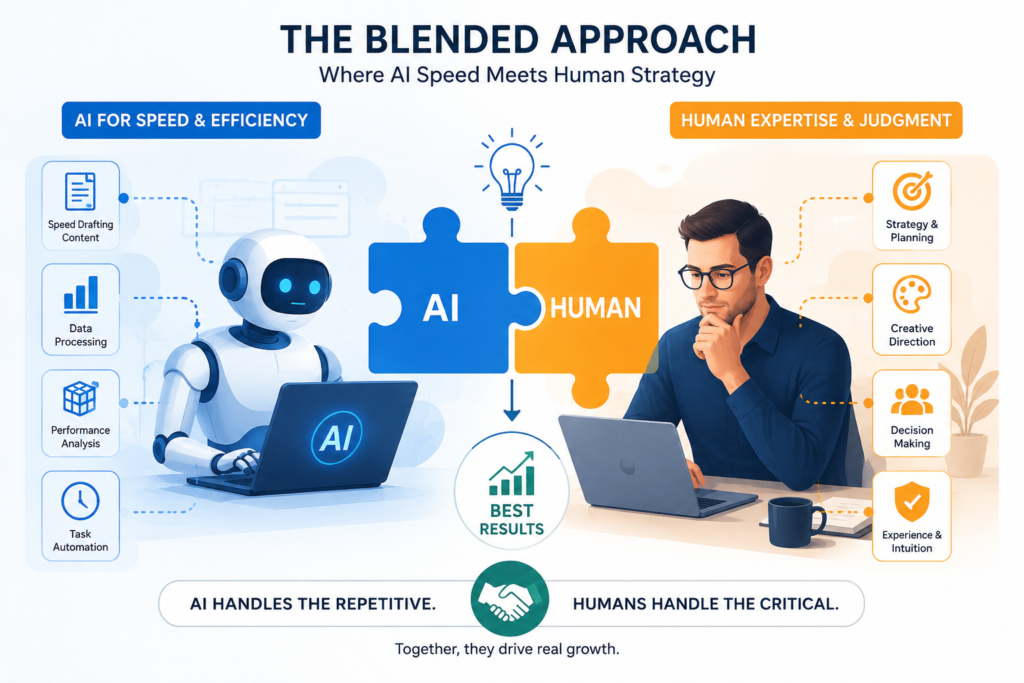
Alt Text: Infographic showing AI speed combined with human strategy.
Most successful businesses today aren’t choosing one side. They’re combining both. They use AI for speed drafting and data processing. AI fully depends on people for strategy, creative direction, and decision-making.
This balanced approach matches what businesses are doing today. McKinsey’s State of AI survey found that almost all surveyed organizations are using AI, yet nearly two-thirds are still in the experimentation or pilot stage rather than fully scaling it across the business. This suggests that AI works best when combined with human expertise instead of replacing it completely.
It’s not about changing one with the other, but it is actually about using each where it fits perfectly. You could think of AI as a fast assistant. It does a lot of fast services, but it still needs directions, and without those directions, things always move around in circles.
Should Your Business Use AI or Hire a Marketing Agency?
Before you decide anything, whether to drop your agency or go all-in on tools, you need to be honest about your situation. First, analyze your main goals, and if you aim to get more blog content out, run basic ad campaigns and even post consistently on social media.
Then yes, AI plus a small team might be enough. However, if you are trying to build a strong brand and enter a new market, it stands the same as with the bigger companies and requires consistent lead flow. When things get complex, that is mostly where people start choosing outside help again, because it is not only about doing more but also about doing the right things.
Digital Brand Management (Still Very Human)
There’s one area where AI still struggles the most.
Managing your brand across different channels.
That includes:
- Answering the review
- Managing customer issues
- Managing tone across platforms
- Dealing with unexpected situations
AI can flag issues. It can track mentions. But deciding how to respond? That’s human territory. And mistakes here are expensive. One wrong response can hurt trust. And trust is already fragile, especially when customers are choosing between multiple options.
What to Look for in an Agency Now
If you do decide to work with an agency, things have changed here, too. You don’t just want someone who ignores AI. That’s outdated. But you also don’t want someone who blindly relies on it. You’re looking for balance.
A good agency today should:
- Use tools to speed up execution
- Still handle strategy themselves
- Be clear about what they do manually vs. with tools
- Understand your specific market
Ask them how they work. Not just what they offer. Because two agencies can sell the same services and deliver completely different results.
The Problem Isn’t Execution, It’s Direction
Imagine a plumber in Texas. The man is doing great at his work, and most of his work comes from referrals, but at the moment, things have slowed down.
Some weeks are busy. Others are quiet. He tries running ads. Gets a few clicks. Not many calls. He tries posting on social media. Inconsistent. Then he tries AI tools. Writes content and runs campaigns, but results are mixed.
Why? Because the issue wasn’t just execution. It was a direction of who he’s targeting. What message is he sending? How he stands out. Those pieces weren’t clear. And without them, even good tools struggle.
Conclusion
AI marketing investment is also getting hot. Statista says that the global AI marketing market is expected to reach about $47 billion USD in 2025 and exceed $107 billion in 2028, which shows that companies are not moving away from AI-powered marketing technologies but continue to invest in them.
In conclusion, AI does not replace marketing companies; it forces them to improve and gives businesses more control over AI to handle things appropriately. The companies that are performing well are not the ones using the most tools, but they are the ones that use them with proper purpose, combining speed with judgment and machines with people. It is not always clean or perfect, but that is how real work usually looks with proper strategies and a plan.
- Will AI replace digital marketers? How safe are marketing jobs really?
 AI can write content, blog posts, and ad copy; schedule… Continue reading Will AI replace digital marketers? How safe are marketing jobs really?