Plenty of websites begin the same way. Someone buys a premium theme for a small fee, installs it over a weekend, and has a decent looking site by Monday. It works well for a year or two. Then the business adds online bookings, a customer portal, or a quote calculator, and the theme starts to push back.
That is usually the moment owners start asking whether custom WordPress development is worth the money. The direct answer is this. If your website mainly presents information, a well maintained theme is usually the better purchase; if the website is part of how your business operates, with bookings, memberships, integrations, or unusual content, custom WordPress development often earns back its cost.
What Is Custom WordPress Development?
Custom WordPress development means building a website’s design and functionality for one specific business, instead of starting from a product made for everyone. Developers write the theme, the plugins, and the integrations around your requirements, with WordPress acting as the content management system underneath.
The work can include custom website design, a custom WordPress theme, custom plugins, tailored content structures, connections to outside services, and backend logic for your business rules. Few projects need all of it. One custom WordPress website might only need a hand coded theme, while another needs the full set.
Custom WordPress Theme vs. Theme Customization
Theme customization starts with an existing theme and changes it through settings, a child theme, extra CSS, or a page builder. A custom theme is written against your own design and contains only the code your site uses.
Picture a dental clinic that needs its logo, colours, and a few service pages. Customizing a premium theme covers that comfortably. Now picture a logistics company that needs a quote form, a shipment lookup and regional landing pages from one editable template. That is where custom WordPress theme development starts to make sense. The WordPress Developer Resources theme handbook explains how themes are structured, which helps you follow a developer’s proposal.
Custom Theme vs. Custom Plugin Development
A theme controls how the site looks. A plugin controls what the site does. Mixing them is a common, expensive mistake. If your booking rules live inside the theme, they disappear the day you redesign. If they live in a plugin, you can change the design without rebuilding the functionality. Good custom WordPress development keeps the two apart.
Custom WordPress Development vs. Ready Made Themes
This table compares the two approaches on the points that usually decide the outcome.
| Factor | Ready made theme | Custom build |
| Initial investment | Low | Higher |
| Design flexibility | Limited to the theme’s layouts | Built around your brand |
| Development time | Days to a few weeks | Weeks to several months |
| Performance potential | Varies, often carries unused features | Can be lean if built well |
| Functionality | Plugins fill the gaps | Built for your workflow |
| Maintenance | Vendor updates; you apply them | You or your developer maintain the code |
| Scalability | Fine for standard needs | Easier to extend if well structured |
| Security responsibilities | Vendor patches; you keep it updated | Your developer owns code quality |
| Content editing | Tied to the theme’s page layouts | Tailored fields and templates |
| Long term costs | Predictable, can rise with workarounds | Higher upfront, steadier if needs are stable |
A lightweight theme from a developer who updates it regularly can serve a standard business site very well. Thousands of sites run the same theme, so bugs get found and fixed quickly.
There are really four routes, not two. A premium theme used as it comes is the cheapest. A customized premium theme adds your branding and some changes. A page builder website uses a visual tool so people who are not developers can arrange layouts, though it often adds extra code that slows pages down. Fully custom development builds everything from scratch. Customized premium themes sit in the middle, and many quietly outgrow their budget, as the next section explains.
Is Custom WordPress Development Worth the Cost?
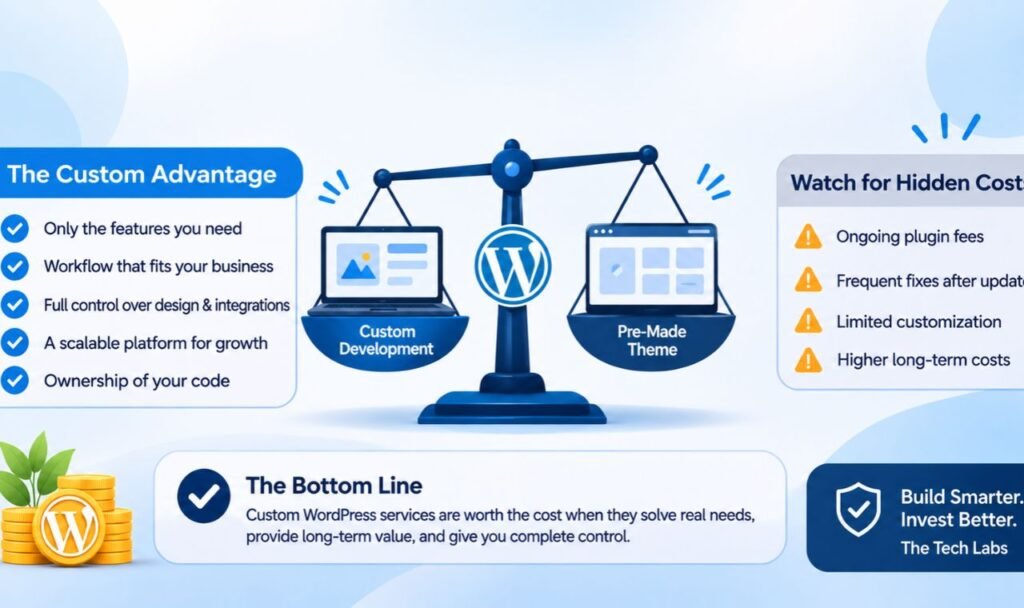
Custom WordPress services are worth the cost when the benefits match a real need. It lets you leave out features you never use, since premium themes often ship with sliders, demo layouts, and settings for dozens of industries. It can follow your workflow, so an editor adds a case study through a form with the right fields instead of fighting a general layout. You also get more control over architecture, branding, integrations with your CRM or payment provider, and room to change direction later.
All of that depends on the quality of the work. A poorly built custom site can be slower, less secure, and harder to maintain than a good theme.
The cheaper route has hidden costs too. A theme that almost fits invites small fixes, extra plugins, and emergency repairs after updates break something. Each fix looks cheap alone. Over three years, they can add up to the price of a proper build, and you still have a site nobody fully understands. Counting that spending honestly is part of answering the worth question.
Ownership matters as well. With custom WordPress development, you should know who owns the source code, whether it is documented, and whether another developer could take over. A site only one freelancer understands is a risk, not an asset.
When Custom Development Is Worth the Investment
These are situations where custom WordPress development usually justifies itself:
- A complex ecommerce store with unusual pricing, product options, or fulfillment rules.
- A membership website with different access levels and gated content.
- A booking platform that must follow specific scheduling rules.
- A site connected to a CRM so leads and customers move across automatically.
- A company with a custom dashboard or client portal.
- An organisation with unusual content, such as courses or directories that do not fit normal posts and pages.
When a Ready Made Theme Is Enough
A premium theme is the better financial decision for small informational sites, personal blogs, early stage startups still testing their offer, basic service websites, and any project with a tight budget or launch date. If you need a homepage, service pages, a contact form, and a blog, custom code mostly buys polish you will not notice. Think carefully before committing to custom WordPress development on a site that does not yet have a clear job, because you can always move to a custom build when growth demands it.
What Does Custom WordPress Development Actually Cost?
Nobody can quote a fair price for custom WordPress development without a scope, and published ranges vary widely by region, developer experience, and project size. Treat any single figure online as a rough signal, not a quote. What you can predict is what moves the price.
Each unique page template needs design, code, and testing, so the number of templates matters. Custom functionality and plugin development usually form the largest variable. Every third party integration, such as payments, shipping, or a CRM, brings its own edge cases. Ecommerce requirements, content migration, and redirects add work. Experienced developers charge more per hour but often need fewer hours. Testing and quality assurance should be in the quote, along with support after launch.
Initial Development Costs vs. Long Term Ownership Costs
The project quote is only the first bill. Running a website also means hosting, domain renewal, licences for paid plugins, backups, security monitoring, updates, and small improvements as the business changes. Premium themes carry licence renewals. Custom builds carry developer time, so there is always an ongoing cost. With custom WordPress development, ask every provider to price the first year of ownership alongside the build, because a cheap quote with no support often costs more by year two.
How Custom WordPress Development Works
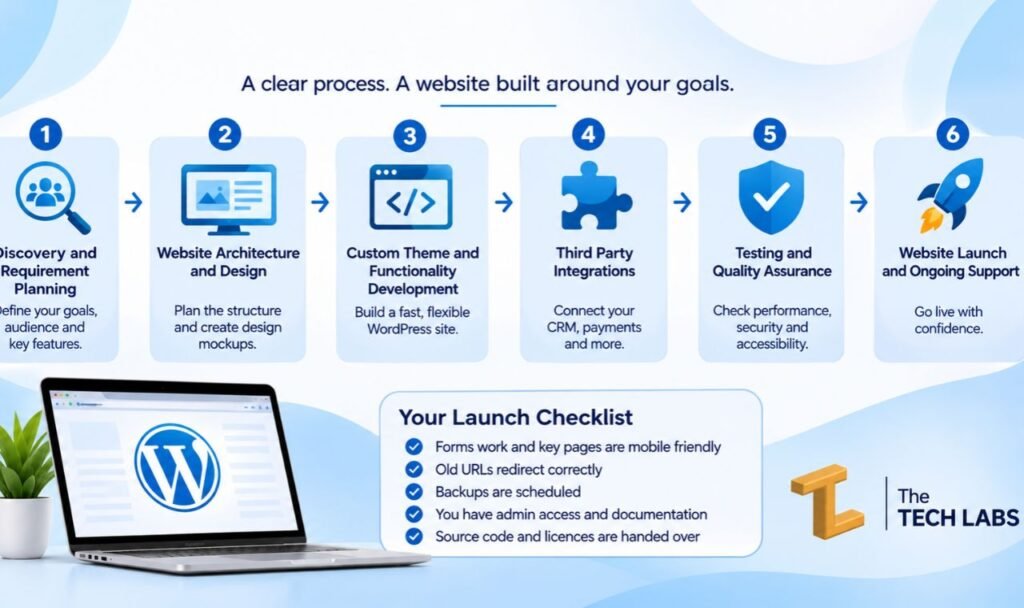
Good providers follow a similar process. Knowing the stages helps you notice when a proposal skips one in custom WordPress development.
Discovery and Requirement Planning
Developers learn your goals, audience, content, current site, and technical needs. You should receive a written scope listing the pages, features, and integrations, along with what is left out. Vague scopes cause most disputes.
Website Architecture and Design
Architecture is how pages, content types, and navigation fit together. Design follows, usually as mockups you approve before any code is written. A good team thinks about how a visitor finds a service and what might stop them from contacting you. Many bring in professional website design services at this stage so the visuals and structure are planned together.
Custom Theme and Functionality Development
Developers build the templates, custom content types, and any plugins. Modern builds often use the Gutenberg block editor, the native WordPress content editor, and Full Site Editing, which lets you adjust headers, footers, and templates visually. Ask which approach your custom WordPress development team plans to use, because it affects how easily your team edits pages later. A provider of WordPress website development services should explain these choices in plain terms.
Third Party Integrations
Payment gateways, CRMs, and booking systems each need to be connected and tested with realistic data. Agree in advance who pays for repairs if an outside service changes how it works.
Testing and Quality Assurance
Testing covers browsers, devices, forms, checkout flows, speed, and accessibility. The W3C Web Content Accessibility Guidelines are the standard reference for accessibility, so they give you something concrete to ask your developer to test against.
Website Launch and Ongoing Support
Before you accept the site, use this handoff and acceptance checklist:
- Every form reaches the correct inbox, and key pages work on mobile.
- Old URLs redirect to the right new pages.
- Backups are scheduled, and a restore has been tested.
- You hold the admin accounts, hosting details, and domain access.
- You have received the source code, documentation, and any licence keys.
Performance, SEO, and Security: What Should You Expect?
Website Performance
Custom WordPress development can produce lean code, but it does not make a site fast automatically. Hosting, image sizes, caching, scripts, and plugins all affect speed. Google’s web.dev guide to Core Web Vitals explains the measures of loading speed, responsiveness, and visual stability and is worth reading before you set performance goals with a developer.
Technical SEO
Custom WordPress development creates room for a sound technical foundation. That includes semantic HTML, a clear heading structure, mobile responsiveness, crawlable navigation, metadata control, correct redirects, and structured data where it fits. It does not guarantee rankings, because authority, competition, and pages built through SEO friendly content writing services do most of the work. If you want search considered from the start, technical SEO and website optimization can run alongside the build instead of arriving after it.
Website Security
Security comes from secure coding, regular updates, tested backups, careful access controls, removing unused plugins, and ongoing monitoring. A site produced by custom WordPress development is not automatically safer than a well maintained theme. Popular themes get attention from many researchers, while custom code depends on your developer’s discipline and your update routine.
How to Choose the Right WordPress Development Partner?
Who delivers your custom WordPress development matters as much as the decision to build. Look for a relevant portfolio with sites you can visit and real custom development experience rather than theme installation. Ask how they structure a plugin. You also want a clear scope, regular communication, a testing process they can describe, documentation another developer could use, support terms you understand, and transparent, itemised pricing. Get written confirmation that you own the source code.
Be wary of guaranteed search rankings, vague quotations, pressure to sign quickly, refusal to share admin access, and unclear ownership terms. Anyone selling custom WordPress development with a promise of first page results is promising something they cannot control.
How to Decide Between Custom Development and WordPress Theme?
Before choosing custom WordPress development, answer these six questions.
- Do you need unique functionality? If not, use a theme. If yes, custom work is justified.
- Can a theme and existing plugins handle it? If a demo already does what you need, buy the theme.
- Does your current website restrict operations? If staff repeat manual workarounds every week, a custom build can remove that cost.
- Are custom integrations necessary? Many services have ready connectors if yours does not, build a custom plugin.
- Is the business prepared for the budget? If not, start with a customized theme and plan the upgrade.
- Will the site change heavily as you grow? If yes, a custom foundation reduces repeated rebuilds.
How The Tech Labs Helps Businesses Build Better Websites?
The Tech Labs describes itself as a development, design, and marketing consultancy based in Karachi, Pakistan. Its website development services include WordPress website development, alongside HTML, Shopify, BigCommerce, Laravel, and React builds. Website design covers landing pages, e-commerce pages, and lead generation pages. SEO services sit next to development, so search visibility can be considered while the site is planned. Its work is shaped around each client’s business requirements. If you are weighing custom WordPress development against a theme, reach out to The Tech Labs and talk through your requirements.
Conclusion
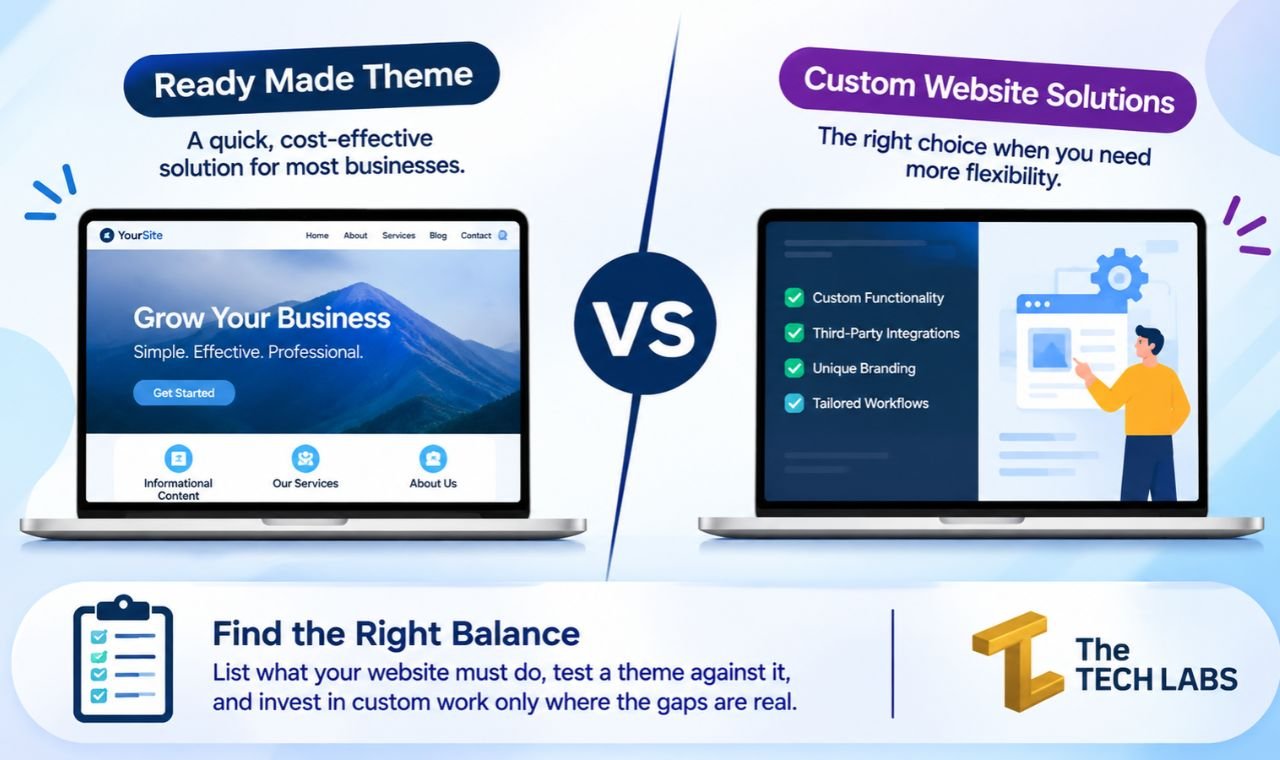
A ready made theme is enough for many businesses, especially when the website is mainly informational and the budget is tight. However, custom website solutions may be worth considering when your functionality, integrations, branding, or internal processes need more flexibility than a standard theme can provide.
Write down what your website must do, test a theme against that list, and invest in custom work only where the gaps are real. If you would like a second opinion, The Tech Labs can review your requirements and help you decide which approach makes the most sense.
Frequently Asked Questions
Q. What is custom WordPress development?
Custom WordPress development is the process of building a WordPress website’s theme, plugins, and features for one business instead of using a prebuilt theme. A developer writes code around your design, content structure, and workflows.
Q. Is custom WordPress development better than using a theme?
Not always. Custom builds are better when you need unique functionality, integrations, or a distinctive brand, while themes suit standard sites with limited budgets. Quality matters more than the label.
Q. How much does a custom WordPress website cost?
There is no standard price. Cost depends on the number of templates, design complexity, custom features, integrations, ecommerce needs, and who builds it, and quotes vary by region. Ask for an itemised scope and include first year running costs in your comparison.
Q. How long does custom WordPress development take?
A simple custom site can take several weeks, while projects with integrations, ecommerce, or complex plugins often run for a few months. Content and approvals affect timelines as much as coding does.
Q. Do the tech labs provide WordPress website development services?
Yes. Its website development services include WordPress website development alongside other platforms, and it also offers website design and SEO. You can contact the team through its website to discuss your project.
- Website Design Services: What You Should Get for the Money
 Two agencies can quote very different prices for what sounds… Continue reading Website Design Services: What You Should Get for the Money