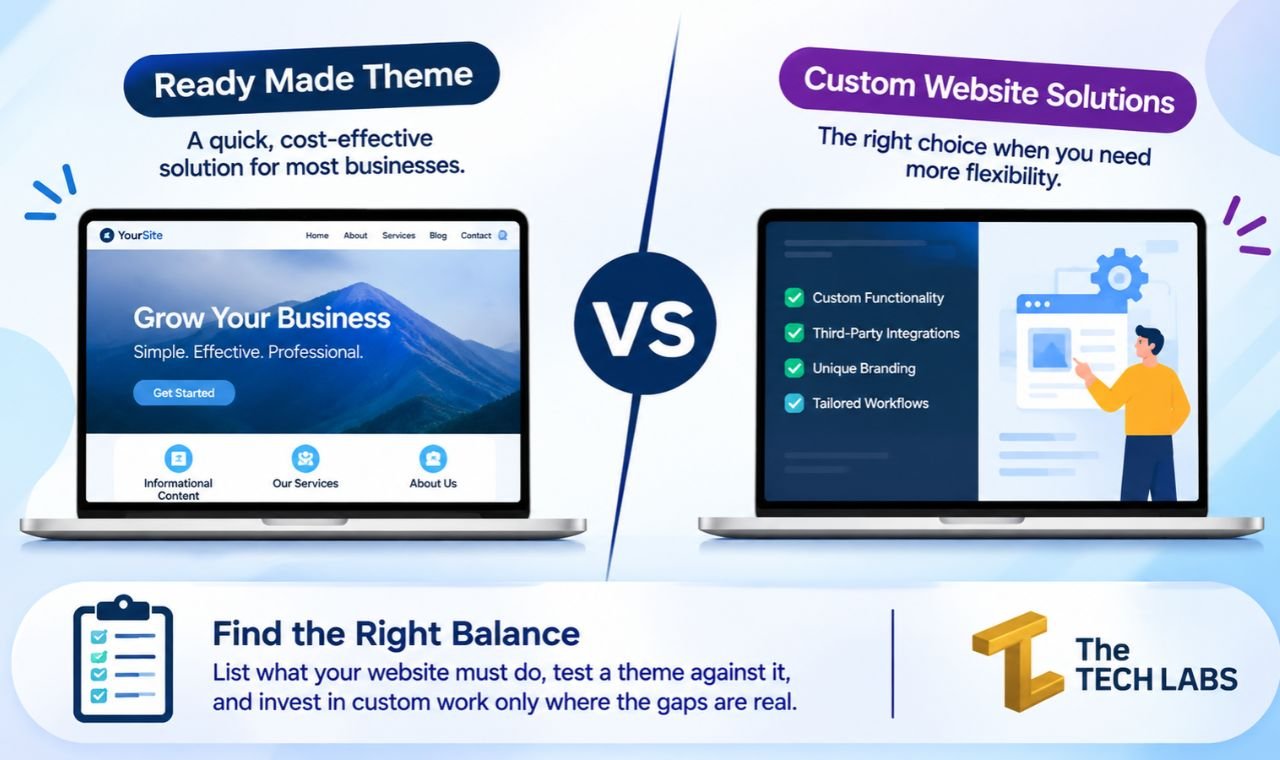
Most owners reach this decision after a small frustration. The site looks dated, a landing page needs a layout the theme cannot produce, or a quote feels far higher than a template. So the question is simple. Do you buy a ready made theme or pay someone to build one? That choice sits at the center of WordPress theme development services. The short answer is this. A premium theme suits a standard business site with a modest budget and common features.
A custom theme suits a business whose branding, layouts, or workflows cannot be handled by a template without heavy workarounds. Budget, timeline, and long term plans decide which side you land on.
This guide compares both routes, from price and performance to vetting a developer. If you are comparing WordPress theme development services right now, use it to ask sharper questions and avoid paying for more than you need.
What Are WordPress Theme Development Services?
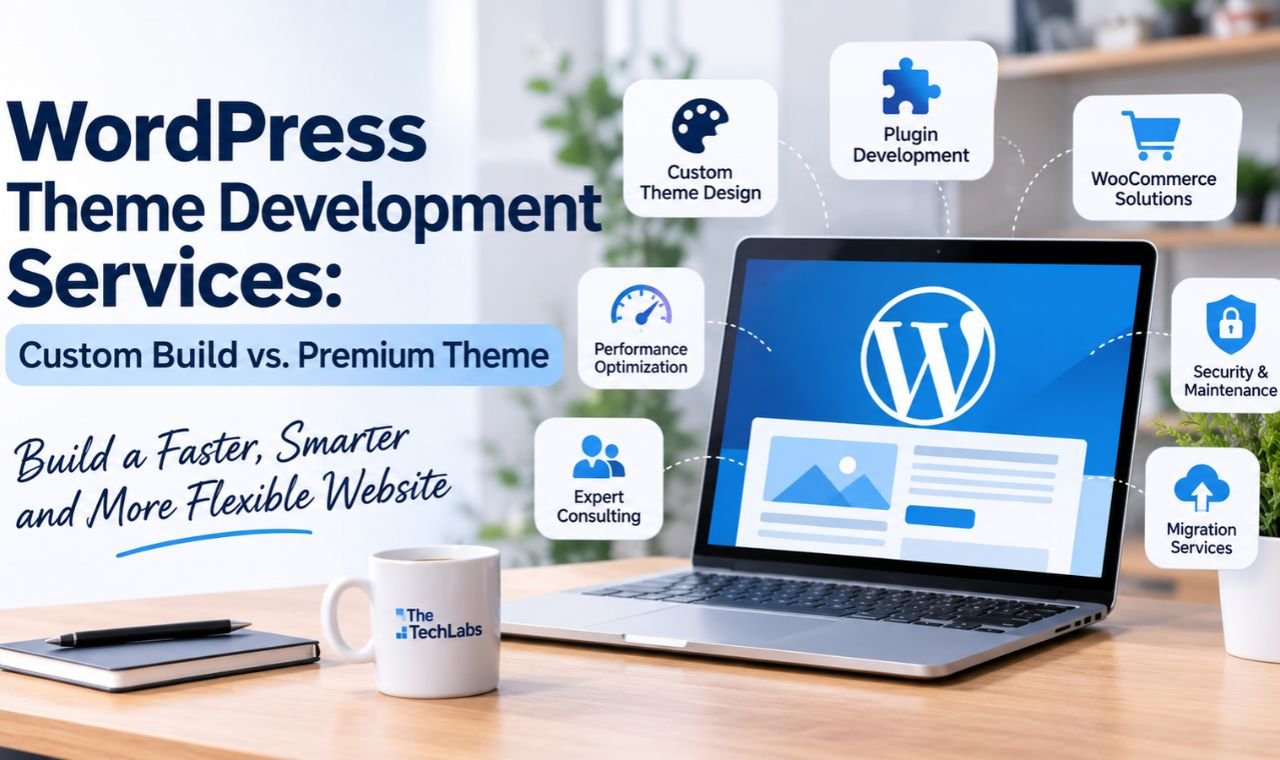
WordPress theme development services cover the design and coding of the layer that controls how your site looks and behaves. The theme sets layouts, fonts, colors, page templates, and how content appears on phones and desktops. Your content lives in WordPress, but the theme decides how it is presented.
A typical engagement covers these pieces:
- Website layout and visual design based on your brand
- Theme architecture, meaning how files, templates, and styles are organized
- Custom page templates and responsive design
- Content management flexibility, so your team can edit without a developer
- Theme customization for colors, fonts, headers, and footers
- Functionality and integrations, such as booking tools or payment gateways
There is a real difference between building a complete theme and modifying an existing one. Complete development creates every template around your needs. Modification adjusts someone else’s theme. Both fall under WordPress theme development services, but effort, cost, and long term results differ a lot.
WordPress supports two theme types. Classic themes use PHP template files. Block themes use HTML templates and a theme.json file for global styles, which enables full site editing in the Gutenberg editor. Kinsta explains how classic and block themes are structured in useful detail.
If your project also needs e-commerce or a wider website development plan, the theme is only one part of the build.
Custom WordPress Theme vs. Premium Theme: What Is the Difference?
A custom theme is built around one business. A premium theme is built to be sold to many. Everything else follows from that. When you weigh WordPress theme development services against a template, these rows matter.
| Factor | Custom theme | Premium theme |
| Initial investment | Higher, built from scratch | Lower license fee plus setup |
| Design flexibility | Very high | Limited to theme options |
| Development time | Longer | Shorter demos exist. |
| Custom functionality | Built around your workflows | Often needs extra plugins or code |
| Performance | Can be lean | Varies; some carry unused features |
| Maintenance | Your developer maintains it. | Vendor updates: you handle compatibility. |
| Scalability | Planned around your growth | Fine until your needs outgrow it. |
| Brand identity | Unique to you | Others may share the design. |
| Technical support | Your developer or agency | The vendor, within their scope |
Neither column wins by default. The right pick depends on which rows matter most to you.
What Is Custom WordPress Theme Development?
Custom WordPress theme development means the theme is planned and coded around your business instead of adapting a general template. A developer studies your content, audience, and how visitors should move through the site, then builds to match. Providers of custom WordPress theme design services usually begin with that research before anyone opens a code editor, often coordinating closely with broader website design services to ensure the visual hierarchy supports user actions.
In practice, WordPress theme development services for a custom build deliver custom layouts, brand specific design, and page templates for things like case studies or product specifications, so editors fill in clear fields. Responsive behavior is designed on purpose, the editing experience keeps your team on brand, and the theme can connect to third party tools such as a booking system or CRM.
Custom development makes sense when the site is central to how you earn, when layout needs are unusual, or when you expect to add features over several years. A clinic with online booking or a manufacturer with a detailed catalog are typical examples.
What Are Premium WordPress Themes?
Premium WordPress themes are paid, ready made themes sold by developers and marketplaces. They usually include pre designed layouts, theme options, importable demo sites, and vendor updates and support.
Premium themes are the main alternative to WordPress theme development services, and they have real strengths. Setup is quick, the upfront cost is lower, and many are well coded and tested across thousands of websites.
The limits show up later. Generic layouts can make your site look like others in your industry. Features you never asked for may load scripts on every page, which can affect website loading speed. Doing something unusual often means stacking plugins. None of this means premium themes are bloated or poorly built. Plenty are excellent. A general purpose product simply carries general features, and when your needs are specific, that is where WordPress theme development services earn their cost.
Custom Theme vs. Premium Theme: Which Is Better for Your Business?
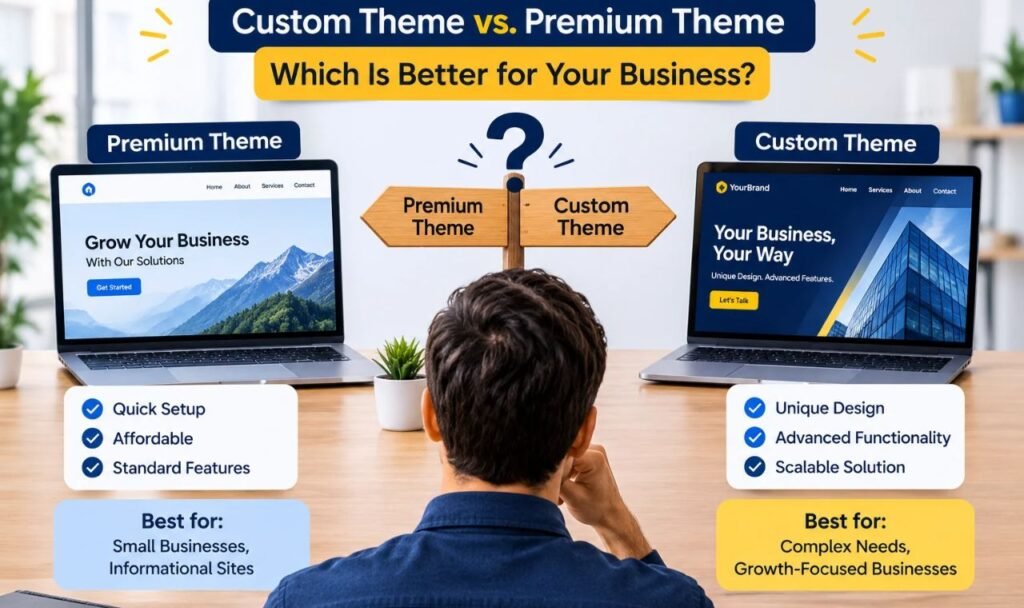
There is no universal winner. Look at what the website must do for your business.
A premium theme is usually enough when:
- You run a small business site with a handful of pages
- The site is mainly informational or standard in function
- You are a startup with a limited budget and need to launch quickly
WordPress theme development services are usually the better investment when:
- Your branding is distinctive, and a template would dilute it
- You need complex layouts no demo can produce
- The site supports specific workflows, such as quote requests or member areas
- You need advanced integrations or specialized functionality
- You plan significant expansion
Two quick examples. A local accountant needs a five page site with a contact form, so a premium theme does the job, and custom work would waste money. A logistics company wants a quote calculator and location pages built from structured data. A template would need heavy bending, so a custom build is easier to maintain.
To decide, ask four questions. Can a demo cover most of your pages? Does anything you want need unusual functionality? Does standing out matter to sales? Where will the site be in three years? If the first answer is yes and the rest are no, start with a premium theme. If the answers flip, request a quote.
What About WordPress Customization Services and Child Themes?
WordPress customization services sit between the two options. A developer adjusts an existing theme to fit you instead of building one or using one untouched.
The safest method is a child theme, a small theme that inherits everything from a parent theme and lets you override styles, templates, and functions. Your changes survive parent updates. Editing parent theme files directly is the mistake to avoid, since the next update can erase your work.
Many providers of WordPress theme development services offer customization too. It is enough when the parent theme already gets you most of the way, and it is where affordable WordPress development often happens, because you reuse a tested foundation. The limits appear when overrides pile up.
A child theme that replaces dozens of templates becomes hard to manage, parent updates may clash with it, and you still carry unused features. At that point, WordPress theme development services stop being a luxury and become the practical choice.
How Do Updates, Maintenance, and Long Term Support Compare?
Premium themes get vendor updates for security and compatibility. Test them on a staging copy, because an update can clash with your plugins or customizations. Vendor support usually covers the theme, not your setup.
A custom theme from WordPress theme development services has no vendor, so maintenance is shared between you and your developer. Agree on who handles core updates, plugin updates, and bug fixes. WordPress website maintenance is easier when code is documented, and plugins stay minimal.
Plugin compatibility matters in both cases. A heavy theme can overlap with plugins you already use, while a lean custom theme leaves you free to choose. Website scalability belongs here too, so ask how future changes get made.
How Much Do WordPress Theme Development Services Cost?
Prices vary by agency, location, and scope, so a fixed number would mislead you. The cost of WordPress theme development services follows effort, and these factors drive it:
- Number of page templates
- Design complexity
- Custom functionality
- Third party integrations
- Ecommerce requirements
- Content migration
- Testing across devices and browsers
- Maintenance and support after launch
A cheap theme is not always a cheap website. Setup, plugins, and developer time add up, and theme customization costs climb quietly when a template does not fit.
The reverse is just as true. Do not buy custom development when a premium theme already meets your requirements. Bespoke templates you do not need only add cost and maintenance. An honest provider of WordPress theme development services will tell you when a premium theme is enough. Ask for a written scope with a line for each template, integration, and revision round, so quotes compare fairly.
What Makes a WordPress Theme Good for SEO and Performance?
Your theme does not decide your rankings. Content quality, search intent, links, and hosting matter too. A theme can avoid creating problems, but no theme, custom or premium, guarantees better Google rankings. Good WordPress theme development services focus on removing obstacles, not making promises.
A theme built well by WordPress theme development services shows these qualities:
- Clean, organized code and semantic HTML
- Responsive layouts and mobile friendly website design
- Logical heading structure with one H1 per page
- Image optimization, such as correct sizing and lazy loading
- Lightweight scripts and plugin compatibility
- Healthy Core Web Vitals
Core Web Vitals are three measurements of real user experience. Largest Contentful Paint, or LCP, is how quickly the main content appears. Interaction to Next Paint, or INP, is how fast the page responds to a tap or click. Cumulative Layout Shift, or CLS, is how much the layout jumps while loading. A theme affects all three through its scripts, fonts, and layout code.
You can test a theme yourself. Chrome’s Lighthouse audits report on performance, accessibility, best practices, and SEO. Run one on a premium demo before buying, and ask providers of WordPress theme development services for results on your staging site before launch. Scores vary between machines, so treat them as guidance, not a verdict.
What Should You Check Before Hiring a WordPress Theme Developer?
Any agency can say it builds themes, so look for proof. Before hiring a provider of WordPress theme development services, check:
- Previous projects and a relevant portfolio, with live sites you can open
- A real grasp of your business requirements, shown by the questions they ask first
- WordPress knowledge, including child themes and block themes
- Responsive design experience on actual phones
- Accessibility awareness, such as keyboard navigation and color contrast
- Testing across browsers, devices, and plugins
- Clear communication and maintenance arrangements
- Ownership and documentation of code, design files, and logins
For accessibility, the A11Y Project checklist is a practical reference to ask a developer to work from.
Before you sign any WordPress theme development services agreement, ask: Who owns the code after final payment? Will I review the site on staging first? How many revision rounds are included? Which plugins will you use, and why?
What Is the WordPress Theme Development Process?
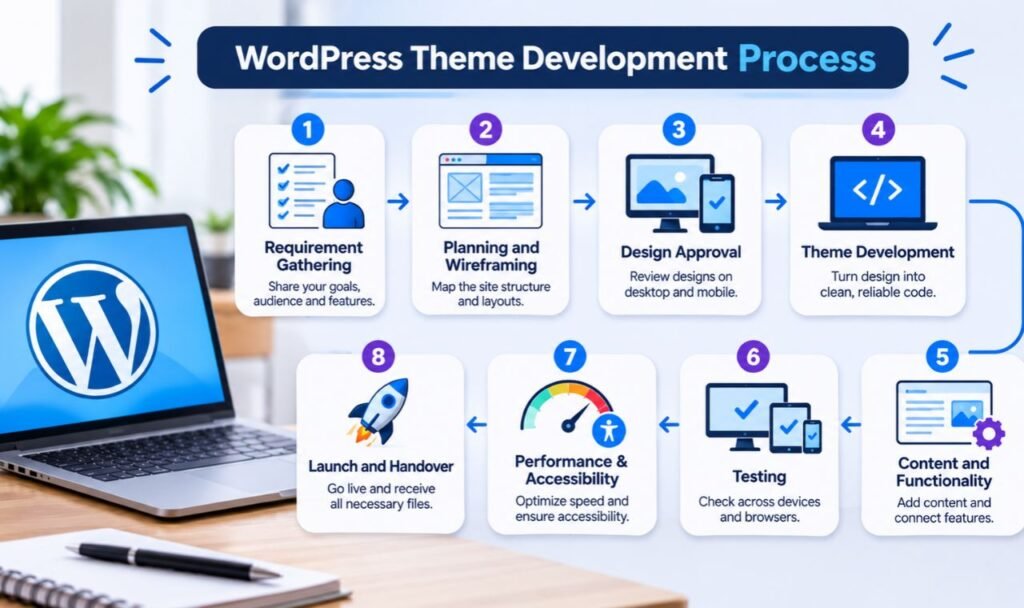
Reputable WordPress theme development services follow a clear process, and any provider should show you theirs in writing. Here is a realistic one.
- Requirement gathering. You explain goals, audience, content, and must have features.
- Planning and wireframing. The developer maps site structure and sketches layouts for your approval.
- Design approval. You review designs for key pages on desktop and mobile. This is the cheapest stage to request changes.
- Theme development. The design is coded into templates and reusable blocks, often shown on a staging site.
- Content and functionality integration. Your content goes in, and forms or other integrations are connected.
- Mobile and browser testing. The site is checked on real devices and common browsers.
- Performance and accessibility checks. Speed, Core Web Vitals, keyboard use, and contrast are reviewed and fixed.
- Launch and handover. The site goes live, and you receive everything needed to run it.
If you want design and build under one roof, a website design service can cover the planning and design stages.
A proper handover from WordPress theme development services includes admin access, theme files, notes on custom templates and plugins, backup arrangements, and a short training session. Agree on maintenance duties in writing.
Why Choose The Tech Labs for WordPress Development?
The Tech Labs describes itself as a development, design, and marketing consultancy. Its service areas include website designing, website development, custom website solutions, search engine optimization, social media marketing, graphic designing, and content writing. That mix matters for a theme decision, because the right build depends on business goals as much as code. Its WordPress page outlines a process from planning through design, development, testing, and launch.
Starting from your goals and budget shows whether a custom build, a premium theme, or customization is the sensible route. If you want to discuss WordPress website development with a team that also handles design and marketing, that is a good first step toward the right WordPress theme development services for your project.
Conclusion
A premium theme gives you speed and a lower starting cost. A custom theme gives you control over design, functionality, and growth. Neither is better in every case, so judge each against what your site truly needs and what your budget allows.
List your requirements, compare real quotes, and ask hard questions. If you want a second opinion on WordPress theme development services, The Tech Labs can review your goals and suggest the right route. Contact the team to start the conversation today.
Frequently Asked Questions
Q. What are WordPress theme development services?
They design and build the theme that controls your website’s layout, styling, and templates, from a full custom build to customizing an existing theme.
Q. Is a custom WordPress theme better than a premium theme?
Not always. Custom suits, unique branding, complex layouts, and specialized functionality. A premium theme is often enough for standard sites with limited budgets.
Q. How much does custom WordPress theme development cost?
It depends on page templates, design complexity, integrations, e-commerce needs, testing, and support. Ask for a written scope to compare quotes fairly.
Q. Can a premium WordPress theme be customized?
Yes. Use theme options, additional CSS, and a child theme for bigger changes. Avoid editing parent theme files directly because updates can overwrite them.
Q. Does The Tech Labs provide WordPress website development services?
Yes. WordPress website development is listed among its services, alongside website design, custom website solutions, and digital marketing.
- WordPress Theme Development Services: Custom Build vs. Premium Theme
 Most owners reach this decision after a small frustration. The… Continue reading WordPress Theme Development Services: Custom Build vs. Premium Theme